Queer Places:
Literatorskie Mostki, Rasstannaya Ulitsa, 30, Sankt-Peterburg, Russia, 192007
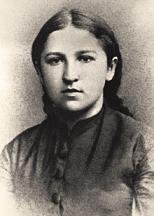 Vera Ivanovna Zasulich (August 8, 1849 - May 8, 1919) was a prominent Russian Marxist theorist, writer, and revolutionary. She became one of the most celebrated figures of the
late 19th-century radical movement after shooting a tyrannical Tsarist official in St. Petersburg and subsequently winning an acquittal in a high-profile trial.
Vera Ivanovna Zasulich (August 8, 1849 - May 8, 1919) was a prominent Russian Marxist theorist, writer, and revolutionary. She became one of the most celebrated figures of the
late 19th-century radical movement after shooting a tyrannical Tsarist official in St. Petersburg and subsequently winning an acquittal in a high-profile trial.
Born into an impoverished noble family, Zasulich became involved with radical political circles in Moscow and St. Petersburg during the 1860s. She participated in
worker artels (collectives) and literacy evening schools.
After evading arrest in 1874, Maria Kolenkina moved to St. Petersburg under an assumed identity and joined Zemlya i Volya
(Land and Liberty). In St. Petersburg, she lived in a close domestic partnership with Vera Zasulich.
In January 1878, outraged by the brutal beating of a political prisoner by St. Petersburg Governor Fyodor Trepov, Kolenkina and Zasulich planned simultaneous
attacks: Vera Zasulich shot and severely wounded Governor Trepov on January 24, 1878. Maria Kolenkina was tasked with assassinating Vladislav Zhelekhovsky, the
prosecutor in the infamous Trial of the 193. However, she was unable to approach Zhelekhovsky on the designated day.
At Zasulich's trial, her defense focused on the moral necessity of protesting government brutality rather than denying the act. The jury acquitted her in a sensational
verdict that made her a international heroine among radicals. To avoid rearrest by police, she fled into exile in Western Europe.
In exile, Zasulich moved away from political terrorism and peasant-based populism. In 1883, she co-founded the Emancipation of Labour (the first Russian Marxist
organization) alongside Georgi Plekhanov and Pavel Axelrod.
She famously corresponded with Karl Marx regarding the revolutionary potential of the Russian peasant commune (obshchina). Later, she helped edit the underground
Marxist newspaper Iskra alongside Vladimir Lenin.
When the Russian Social Democratic Labour Party split in 1903, Zasulich joined the Menshevik faction, favoring broad-based political organizing over Lenin's
centralized Bolshevik model.
She returned to Russia following the 1905 Revolution but largely retired from active politics. She opposed the Bolshevik seizure of power in October 1917 and died in
Petrograd in May 1919.
Historical records regarding Vera Zasulich do not identify her as lesbian or queer, but her life connects to LGBTQ+ history and modern queer perspectives in a few
notable ways:
Historical accounts document heterosexual relationships in her personal life. Her primary long-term romantic partnership was with fellow revolutionary Lev Deich (Leo
Deych). They lived together in exile during the late 1870s and 1880s until Deich was arrested and exiled to Siberia.
While Zasulich was not part of an explicit LGBTQ+ movement, 19th-century Russian radical movements (such as the Nihilists and Narodniks) were known for rejecting
traditional Tsarist family structures, arranged marriages, and patriarchal norms. Female revolutionaries frequently lived in mixed-gender or all-women communal
households (artels) and practiced "fictitious marriages" to gain financial and legal independence from their parents.
Zasulich served as the historical inspiration for Oscar Wilde's first play, Vera; or, The Nihilists (1880). Modern adaptations
of Wilde's play have frequently been framed around LGBTQ+ themes:
In 2014, a NYC production staged Wilde's play featuring an all-male cast of queer performers, specifically recontextualizing Zasulich’s story as a theatrical protest
against anti-LGBTQ+ legislation in Russia.
Although Zasulich herself did not focus on sexual politics in her writings, the broader European Social Democratic movement of her era (late 19th/early 20th century)
began the earliest political dialogues around gay rights. Contemporaries in the German SPD—such as August Bebel and Eduard Bernstein—were among the first political
figures to advocate for the decriminalization of homosexuality in Europe.
References:
- https://en.wikipedia.org/wiki/Vera_Zasulich
- https://www.encyclopedia.com/women/encyclopedias-almanacs-transcripts-and-maps/zasulich-vera-1849-1919
Support this project
This website is a passion project researched, developed, and funded entirely by me. If you find the content valuable and would like to help support the ongoing research and hosting costs, any contribution is deeply appreciated.
Thank you for keeping this independent resource alive!
My books on Amazon: Elisa Rolle's books
BACK TO HOME PAGE